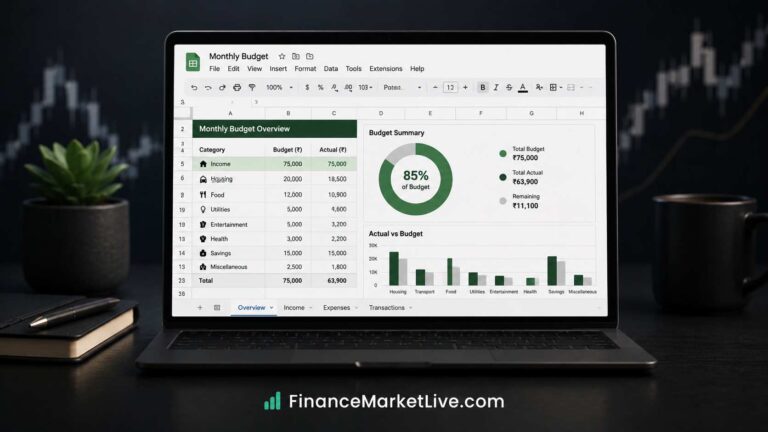

The 50/30/20 Rule: Does It Actually Work in 2025?
The 50/30/20 rule is a budgeting method that divides after-tax income into three categories: 50% for needs, 30% for wants, and 20% for savings and debt repayment. It works best for stable incomes in moderate-cost areas, but high housing costs and inflation in 2025 make it unrealistic for many Americans.
Housing data tells the story. According to the Federal Reserve’s 2025 Survey of Household Economics and Decisionmaking, the median U.S. renter now spends 35% of income on housing alone, up from 28% in 2020.
Meanwhile, total U.S. credit card debt hit $1.13 trillion in Q1 2025, and a 2025 Bankrate survey found that 54% of Americans still live paycheck to paycheck. The economic conditions that made 50/30/20 popular in 2015 no longer match reality for millions of households.
This article breaks down exactly how the 50/30/20 rule works, shows real math for what happens when you try it on a $60,000 salary in New York City versus Cleveland, and explains when the rule makes sense versus when you should use a different method. You will see the actual numbers that make 50/30/20 fail in high-cost cities and learn alternatives that work better for debt payoff or building emergency savings.
How the 50/30/20 Rule Actually Works

The 50/30/20 rule was popularized by Senator Elizabeth Warren in her 2005 book “All Your Worth: The Life’s Money Plan.” The method takes your monthly after-tax income and splits it into three buckets: 50% for needs, 30% for wants, and 20% for savings and debt repayment. The simplicity is its main advantage. You do not need to track every coffee or grocery item. You just check whether your spending falls into the right percentage range.
The Three Buckets Explained
Needs include expenses you must pay to survive and work: rent or mortgage, utilities, groceries, minimum debt payments, car payment or public transit, and basic insurance. Wants include discretionary spending: dining out, streaming subscriptions, vacations, hobbies, and upgraded versions of basics. Savings and debt repayment include emergency fund contributions, retirement accounts, investment accounts, and extra debt payments above the minimum.
The rule does not allow you to move money between buckets freely. If your needs exceed 50%, you must either reduce wants or increase income. This constraint forces a decision about lifestyle or location. Elizabeth Warren specifically designed the rule to prevent guilt about spending on wants while still building savings. The 30% wants bucket exists intentionally, not as leftover money after bills.
After-Tax Income Is the Starting Point
The 50/30/20 rule uses after-tax income, not gross salary. This distinction matters because taxes vary by state and income level. For example, someone earning $60,000 in Texas takes home about $4,500 per month after federal and FICA taxes, while the same salary in California yields roughly $4,200 after taxes. Using gross income as the starting point creates a budget that fails from day one. You should calculate your actual monthly deposit amount and use that as your base.
For people with variable income such as freelancers, the rule requires modification. You should base your budget on your lowest-earning month, not your average. Any surplus from higher-earning months goes into savings or debt repayment first. This approach prevents overspending during good months and creates a buffer for bad months. Our article on budgeting on a variable income as a freelancer covers this adaptation in detail.
Why the 50/30/20 Rule Fails in 2025 for Many Americans
The 50/30/20 rule assumes that essential costs occupy roughly half of your income. This assumption held fairly well in 2015 when the rule gained popularity. However, post-pandemic inflation and housing market shifts have broken this assumption for many households. Meanwhile, wage growth has not kept pace with cost increases in major metro areas. The result is that the 50% needs bucket often becomes 60% or 70% in high-cost cities.
Housing Costs Break the 50% Rule
Housing is typically the largest single expense in any budget. In 2025, the median one-bedroom apartment rent in New York City is approximately $3,800 per month, while San Francisco averages $3,400 and Boston averages $3,200.
For someone earning $60,000 annually in New York City, that means rent alone consumes 76% of the 50% needs bucket before accounting for utilities, food, or transportation. The math simply does not work unless you accept roommates or long commutes.
Even in moderate-cost cities, the 50% needs bucket often fails. The median rent for a one-bedroom apartment in Atlanta is $1,650 per month in 2025, according to Apartment List data. Someone earning $50,000 in Atlanta takes home about $3,700 monthly after taxes.
Rent alone becomes 45% of income before utilities, groceries, or insurance. This leaves only 5% for all other needs, which is impossible for most households. The 50% threshold assumes housing costs remain reasonable relative to income, and that assumption no longer holds in 2025.
Inflation Erodes the 30% Wants Bucket
Grocery prices remain 25% higher than 2020 levels according to the Bureau of Labor Statistics CPI data from early 2025. Transportation costs have also increased significantly. The average cost to own and operate a car is $1,200 per month in 2025, up from $950 in 2020. These increases push needs higher while the 50% bucket stays fixed. Consequently, the 30% wants bucket shrinks in real terms even though the percentage stays the same.
When needs exceed 50%, people typically cut from the wants bucket first. This creates a budget that feels punishing and unsustainable. The 30% wants category exists to make budgeting psychologically viable, but when it becomes 15% or 10% in practice, you lose that psychological benefit.
The rule then becomes another source of financial stress rather than a solution. For a deeper look at why budgets fail even when people follow the rules, see our article on why your budget fails every month.
Real-World Example: 50/30/20 on a $60,000 Salary in NYC vs. Midwest
The following comparison shows exactly how the 50/30/20 rule plays out in two different cities for someone earning $60,000 annually. Both examples use 2025 rent data and actual cost estimates.
The New York City example demonstrates why the rule fails in high-cost areas, while the Cleveland example shows where it remains realistic. This is not a theoretical exercise. These are the actual numbers people face when trying to apply 50/30/20 in 2025.
| Category | 50/30/20 Target (Monthly) | NYC Actual (Monthly) | Cleveland Actual (Monthly) |
|---|---|---|---|
| After-tax income | $4,500 | $4,500 | $4,500 |
| Needs target (50%) | $2,250 | $2,250 | $2,250 |
| Rent (1-bedroom) | Part of needs | $3,800 | $1,200 |
| Utilities + internet | Part of needs | $150 | $130 |
| Groceries | Part of needs | $400 | $350 |
| Transportation | Part of needs | $130 (subway pass) | $200 (car payment + insurance + gas) |
| Total needs | $2,250 | $4,480 | $1,880 |
| Needs % of income | 50% | 99.6% | 41.8% |
| Wants target (30%) | $1,350 | $0 | $1,350 |
| Savings target (20%) | $900 | $0 | $900 |
| Remaining after needs | $2,250 | $20 | $2,620 |
The New York City example shows that rent alone exceeds the entire needs budget. This means the person cannot pay rent and follow the 50/30/20 rule at the same time. They must choose between housing and savings.
The Cleveland example shows that after paying needs, $2,620 remains. This allows the person to hit both the wants and savings targets while still having a $370 buffer. The same salary produces completely different budget outcomes based on location. For a detailed comparison of budgeting methods and when each works best, see our article on zero-based budgeting and how it compares to 50/30/20.
When the 50/30/20 Rule Still Makes Sense (and When It Does Not)

The 50/30/20 rule works best for people with stable incomes living in moderate-cost areas where housing consumes less than 30% of after-tax income. This includes many mid-sized cities in the Midwest and South, where median rents range from $1,000 to $1,400 for a one-bedroom apartment. It also works well for people who already own their home with a fixed mortgage, since housing costs become predictable and often fall below the 50% threshold.
The rule does not work for people paying market-rate rent in high-cost cities, those with high debt payments relative to income, or anyone whose essential expenses already exceed 50% of take-home pay.
It also fails for people with irregular income who cannot reliably predict their monthly deposit amount. In these cases, the rule creates frustration rather than clarity. The constraint of 50% for needs becomes a source of guilt when reality demands 65% or 75%.
Additionally, the 50/30/20 rule does not account for life stage differences. A 25-year-old single professional has different needs than a 40-year-old parent with two children. The rule treats both households identically, which ignores the reality that family expenses often exceed 50% of income even in moderate-cost areas. The rule also does not help prioritize which debt to pay off first or how much to save for retirement versus an emergency fund. It provides a framework but not a complete financial strategy.
Better Alternatives to 50/30/20 in 2025
When the 50/30/20 rule does not fit your situation, you should consider alternative budgeting methods that match your actual expenses and goals. The three most effective alternatives are zero-based budgeting, pay-yourself-first, and the reverse 50/30/20 approach. Each method addresses different problems and works better for specific situations. The table below compares all four methods across four practical dimensions to help you choose.
| Method | Best For | Time Required | Debt Payoff Power | Flexibility |
|---|---|---|---|---|
| 50/30/20 Rule | Moderate-cost areas, stable income | 15–20 minutes monthly | Medium (automatic 20%) | High (30% wants buffer) |
| Zero-Based Budgeting | Debt payoff, tight cash flow | 60–90 minutes setup, 10 min weekly | High (every dollar assigned) | Medium (requires monthly rebuild) |
| Pay-Yourself-First | Savings automation, low-discipline users | 30 minutes setup, then automatic | Low (savings prioritized, not debt) | Very high (spend rest freely) |
| Reverse 50/30/20 | High-cost cities, high rent | 20 minutes monthly | Medium-high (adjusts needs upward) | High (flexible percentages) |
Zero-based budgeting gives you maximum control by assigning every dollar to a specific category before the month begins. This method works best when you need to eliminate wasteful spending or pay off debt aggressively.
The pay-yourself-first method automates savings by transferring money to retirement or emergency funds immediately after payday, then letting you spend the rest without tracking. This works well for people who track spending but struggle to save consistently.
The reverse 50/30/20 approach starts with your actual needs percentage, then splits the remaining income between wants and savings. This method works in high-cost cities where needs exceed 50%.
For people focused on cutting expenses without major lifestyle changes, the article on how to cut monthly expenses by 20% without changing your lifestyle provides specific strategies that work within any budgeting method. The key insight is that the best budgeting method is the one you actually use consistently.
A simple method you follow beats a perfect method you abandon after two months. According to the Consumer Financial Protection Bureau (CFPB), the most effective budget is one that matches your financial situation and behavioral style, not the one that looks best on paper.