Cash Envelope System: Does It Work Better Than Digital Budgeting?
The cash envelope system is a budgeting method where you withdraw cash for spending categories and put it in labeled envelopes. When the cash is gone, you stop spending in that category. Research shows it reduces spending by 12–18% compared to digital payments, but it works best as a hybrid approach for problem categories only.
According to a 2025 Bankrate survey, 54% of Americans still live paycheck to paycheck. Credit card debt hit $1.13 trillion in Q1 2025, and cash usage has dropped 40% since 2020 as contactless payments become normal. However, cash still works better than digital payments for people who overspend with cards. The physical act of handing over cash creates more psychological pain than swiping a card, which slows spending and reduces impulse purchases.
This article explains how the cash envelope system works step by step, presents research data on how much spending decreases when you switch to cash, and compares cash envelopes head-to-head with digital budgeting across five practical dimensions. You will learn which categories work best with cash, how to use a hybrid approach that combines cash for problem categories with digital tracking for everything else, and how to use cash safely without carrying dangerous amounts of money. For a step-by-step guide on building your budget structure first, see our article on zero-based budgeting and how to assign every dollar a job.
How the Cash Envelope System Works Step by Step
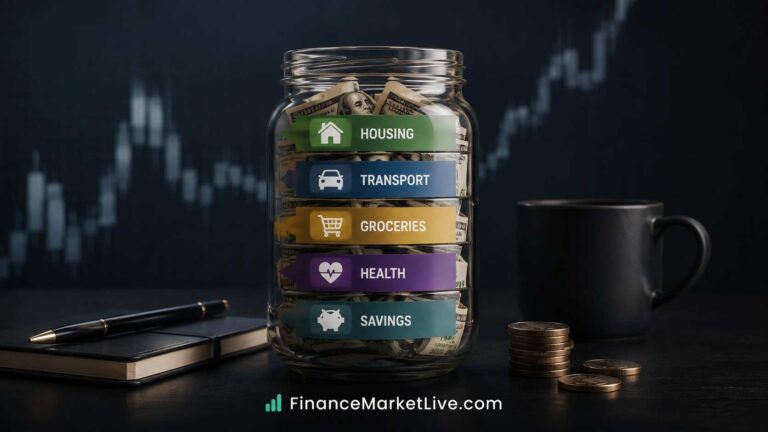
The cash envelope system converts your budget for variable spending categories into physical cash that you withdraw at the beginning of each month. You label envelopes by category, distribute the cash, and only spend from the envelope when you buy something in that category. When the envelope is empty, you stop spending in that category until next month. This hard limit prevents overspending that happens with digital payments.
The Basic Process
Start by listing your variable spending categories: groceries, dining out, entertainment, gas, personal care, clothing, and miscellaneous. For each category, write down your monthly budget limit based on your actual past spending. Withdraw the total amount in cash from your bank or ATM. Label an envelope for each category and put the corresponding cash inside. For example, put $400 in the groceries envelope, $150 in the dining out envelope, and $100 in the entertainment envelope.
When you go shopping, bring only the envelopes for categories you will use. If you are buying groceries, bring the groceries envelope. Pay with cash from that envelope and put the receipt in the envelope. When you get home, track the spending in your budget spreadsheet or app to keep your records accurate. When the groceries envelope is empty, you stop buying groceries until next month. You can eat what is in your pantry or wait until the next month’s cash arrives.
Which Categories Work Best With Cash
Cash works best for categories where you tend to overspend consistently. These are typically variable expenses with no fixed amount: groceries, dining out, entertainment, shopping, and miscellaneous. Cash does not work well for fixed expenses like rent, car payment, or insurance because these amounts do not change and you pay them online or by check. Use cash only for problem categories, not for your entire budget.
| Category | Best For Cash | Typical Monthly Limit | Why It Works |
|---|---|---|---|
| Groceries | Yes, if you overspend | $350–500 | Impulse purchases drop significantly |
| Dining out | Yes, if you overspend | $100–200 | Hard limit stops extra orders |
| Entertainment | Yes | $50–150 | Clear stop point when cash runs out |
| Gas | No, use debit card | $100–200 | Most gas stations do not accept cash easily |
| Shopping | Yes, if you overspend | $50–150 | Physical pain of handing over cash reduces purchases |
| Utilities | No, pay online | N/A | Fixed amount, paid online for convenience |
Research Data: Does Cash Actually Reduce Spending
Multiple studies confirm that people spend less when they use cash instead of digital payments. The most cited research comes from MIT and the University of Chicago, which found that people spend 12–18% less when paying with cash compared to credit cards. This difference is not because people budget better with cash. The difference is because cash creates more psychological pain than digital payments.
MIT Study: 12–18% Less Spending With Cash
In a landmark study published in the Journal of Consumer Research, MIT researchers conducted experiments where participants bid on items using either cash or credit cards. Participants using cash bid significantly lower amounts than those using credit cards. The researchers called this the “pain of paying.” Cash makes the cost feel more real because you physically hand over money. Credit cards delay the pain until the bill arrives, which弱ens the connection between spending and cost.
A follow-up study by University of Chicago researchers found that sports team ticket buyers spent 17% less when required to pay with cash instead of credit. The difference was even larger for impulse purchases. People who planned to buy a ticket still bought it with cash, but they bought fewer add-ons like parking and merchandise. This pattern holds for groceries, dining out, and shopping. The cash limit stops the extra spending that happens after the planned purchase.
Why Cash Creates More Pain Than Digital Payments
The psychological mechanism is called “mental accounting.” When you pay with cash, you see your money leave your hand and enter the merchant’s hand. This transaction feels real and final. When you pay with a card, you see a number on a screen decrease, but the money stays in your account until the bill arrives weeks later. This delay weakens the connection between spending and consequence.
Digital payments also reduce friction. Tap-to-pay and one-click checkout make spending almost effortless. Cash requires more steps: find your wallet, find the right bill, count out the amount, hand it over, get change. Each step creates a moment where you can decide not to buy. These moments add up and reduce total spending. The friction is not a bug. The friction is the feature that makes cash work better for overspenders.
Cash Envelopes vs. Digital Budgeting: Head-to-Head Comparison
The following comparison shows how cash envelopes and digital budgeting perform across five practical dimensions. This comparison assumes you use a budgeting app like YNAB or EveryDollar for digital budgeting. The table helps you decide which method works better for your situation based on your spending patterns and preferences.
| Dimension | Cash Envelope System | Digital Budgeting App |
|---|---|---|
| Spending reduction | 12–18% less (research-backed) | 5–10% less (mixed results) |
| Convenience | Low (must withdraw cash, carry envelopes) | High (automatic tracking, no cash needed) |
| Security | Low (cash can be lost or stolen) | High (fraud protection, bank security) |
| Setup time | 30–45 minutes monthly | 1–2 hours initial, then automatic |
| Best for | Chronic overspenders, card users who cannot stop | People who track consistently, prefer convenience |
Cash envelopes win on spending reduction but lose on convenience and security. Digital budgeting wins on convenience and security but loses on spending reduction for chronic overspenders. The choice depends on your specific problem. If you consistently overspend with cards despite using a budgeting app, cash envelopes will work better. If you track spending consistently and do not overspend dramatically, digital budgeting is more convenient and safer.
For people who want to compare digital budgeting apps and find the best free option, see our article on best free budgeting apps in 2025. The app comparison includes YNAB, EveryDollar, and free alternatives that work with both cash and digital spending tracking.
The Hybrid Approach: Best of Both Worlds
The hybrid approach uses cash envelopes for problem categories and digital tracking for everything else. This method gives you the spending reduction of cash without the inconvenience of carrying cash for every purchase. You withdraw cash only for categories where you consistently overspend, such as groceries, dining out, or shopping. You pay for everything else with debit or credit cards and track it automatically in your budget app.
For example, you might use cash envelopes for groceries ($400), dining out ($150), and entertainment ($100), which totals $650 in cash per month. You pay rent, utilities, gas, and insurance with your debit card and track them in your budget app. This approach reduces spending in problem categories by 12–18% while keeping convenience for everything else. You also reduce security risk because you only carry $650 instead of your entire monthly budget.
To set up the hybrid approach, first identify which categories cause overspending by reviewing your past two months of spending. Look for categories where you consistently exceed your budget. These are your cash envelope categories. Set realistic limits based on actual spending, not wishful thinking. For help identifying your overspending patterns, see our article on why your budget fails every month. The diagnostic checklist helps you pinpoint which categories need cash envelopes.
Security Risks and How to Use Cash Safely
Cash carries security risks that digital payments do not. If you lose cash or it gets stolen, you cannot recover it. Digital payments have fraud protection and you can cancel a card. Cash is final. This risk means you should limit the amount of cash you carry and store at home. The general rule is to never carry more than $200 in cash at once and to keep total cash under $500.
Limit cash envelope totals to $500 per month. If your problem categories exceed $500, reduce the limits or use prepaid debit cards instead of cash for the excess. Prepaid cards work like cash envelopes but have better security. You can load $200 onto a prepaid card for groceries, another $150 for dining out, and track them separately. If the card gets stolen, you can freeze it and recover the remaining balance.
Store cash envelopes in a secure location at home, such as a lockbox or safe. Do not keep all envelopes in one place. If you carry cash in your wallet, keep only the envelope for the category you will use that day. Put the rest at home. This limits your loss if your wallet gets stolen. Always keep receipts in the envelope so you can track spending and reconcile with your budget app. According to the Consumer Financial Protection Bureau (CFPB), using cash for budgeting is safe as long as you limit amounts and store it securely, but fraud protection on cards is superior for large purchases.